Understanding Pavement: Unlocking Frameworks to Better Understand WPT
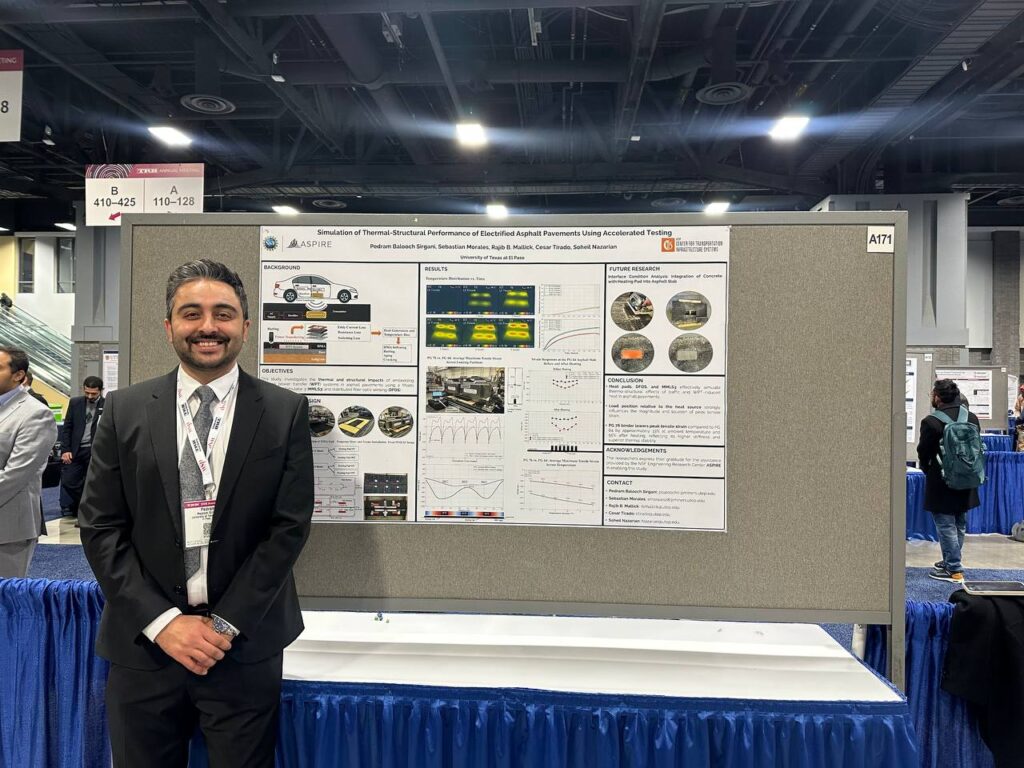
As the path to an electrified future expands with in-motion charging capabilities, allowing vehicles to charge as they drive down an electrified road, ASPIRE is leading the charge through research on these electrified roadways and implications — including the effect of temperature on the road.
These wireless power transfer (WPT) systems generate heat waste that must then be dissipated through the pavement. ASPIRE Ph.D. Candidate Pedram Balooch Sirgani is researching the thermal implications of embedding these WPT systems in flexible pavements as a part of the ASPIRE: Electrified Roadways Project.
“The results show that localized temperature increases due to simulated WPT waste heat can significantly elevate tensile strains in the asphalt layer, even under modest surface temperature changes,” he explained.
In other words, even moderate levels of heat generated as waste from the operation of the WPT system can increase strain, which is a critical parameter in flexible pavement design, within the asphalt pavement structure. This heating influenced not only the magnitude but also the spatial distribution of strain in the asphalt pavement, indicating the need for further research.
“Key findings from this research indicate that combining controlled heating with accelerated loading provides an effective framework for evaluating the coupled thermal-structural behavior of asphalt pavements with embedded WPT components,” Balooch Sirgani said.
This research built upon his previously published work, “Characterizing Pavement Material Properties for Thermal Modeling of Embedded Wireless Power Transfer Systems,” which was presented at an earlier Transportation Research Board (TRB) conference.
“Together, these studies represent a continuous research effort aimed at developing a more comprehensive understanding of how WPT-induced waste heat influences pavement performance and design considerations,” Balooch Sirgani shared.
Balooch Sirgani was instrumental in this continuation of the University of Texas at El Paso team’s research.
“Under the supervision and guidance of Professor Mallick and Professor Nazarian, I was closely involved in the study conception and experimental design, carried out a substantial portion of the data collection and analysis, and collaborated with the research team in interpreting and presenting the findings,” he said. “I was actively involved in drafting and revising the manuscript.”
At the TRB conference in January, Balooch Sirgani presented a poster highlighting their research findings, interacting with attendees to share and discuss their methodology and questions for further study.
“Presenting this research at the TRB conference was a valuable opportunity to share ongoing ASPIRE-supported work with a broad audience of researchers, practitioners, and agency representatives working at the intersection of transportation infrastructure and electrification,” he shared. “Several attendees expressed interest in the work and offered recommendations regarding future collaborations and career opportunities, including follow-up conversations related to potential job offers.”
For the latest news, publications, and research highlights from ASPIRE, visit aspire.usu.edu.
About ASPIRE:
ASPIRE, a National Science Foundation Engineering Research Center headquartered at Utah State University, leads groundbreaking research and development to accelerate electrification. With over 400 global collaborators, ASPIRE focuses on creating seamless, affordable electrified transportation systems, accessible for all vehicle classes, along with the public infrastructure needed to support them. By reducing emissions, improving air quality, and fostering economic growth through job creation and workforce training, ASPIRE’s work spans engineering, social science, policy, and business. Partnering with top universities, industry leaders, and community groups, ASPIRE is driving the future of advanced transportation. Learn more at aspire.usu.edu.
Contacts:
Kat Webb
Content Director
Marketing & Communications
ASPIRE ERC
Writer:
Kayleigh Kearsley
Marketing & Communications Intern
ASPIRE ERC