Optimizing the Cost of EV Charging

As electric vehicles are more widely adopted across the nation, ASPIRE researchers are finding ways to optimize EV charging and reduce costs for EV owners while also reducing the overall impact on the grid. Utah State University Ph.D. candidate Jackson Morgan was the first author on a new research publication that optimizes EV charging by considering both the impact to the grid and the cost to the user.
“The methods we developed can reduce energy costs, reduce grid capacity needs, and smooth out demand on the local distribution network,” Morgan said. “Additionally, we showed that greater cost savings could be achieved in some cases by extending select EV charging sessions — savings which would be passed along to the end user.”
This research, a part of ASPIRE’s Charging Stations of the Future project, built on a previous study Morgan presented concerning the cost effectiveness of scheduling charging EV times, offering further solutions that considered other aspects of the grid to optimize the EV charging experience.
Co-advisor Hongjie Wang, an electrical and computer engineering associate professor at Utah State University, further emphasized the impact of this research entitled “Reservation-Based Optimization of Electric Vehicle Charging Considering Dynamic Pricing and Operating Envelopes.”
“The research outcome has the potential to reduce EV ownership cost, improve the profitability of commercial EV charging infrastructure, and facilitate the widespread adoption of transportation electrification, which are critical for ASPIRE’s mission and general societal impacts,” he added.
Morgan worked with Wang and others at ASPIRE to discover these outcomes.
“My role in the research process was to develop the underlying methodology for optimizing EV charging,” Morgan explained. “I formulated the problem mathematically, collected real-world grid and EV data, and applied the methods to demonstrate how we can reduce the costs of EV charging.”
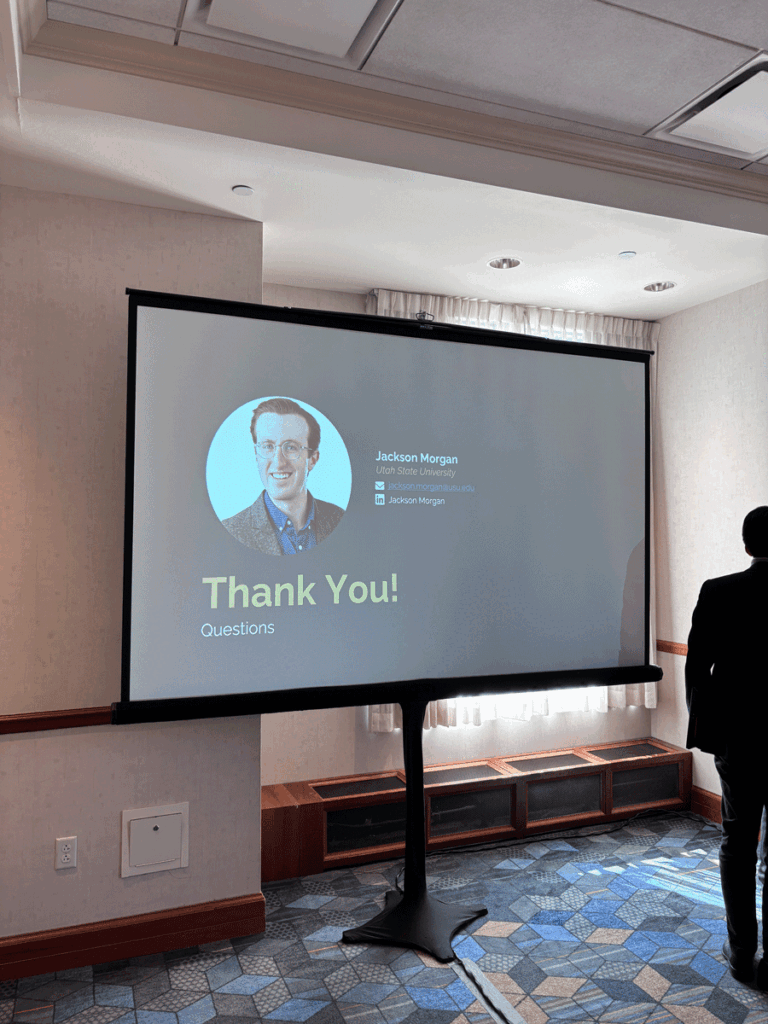
Morgan’s hard work and efforts didn’t go unnoticed by his faculty advisors.
“Jackson is an excellent researcher who is always motivated and has the passion to address challenges in real-world applications related to transportation electrification,” said Wang. “From the internship and work experience with utility companies, Jackson brings those practical aspects into his research and solution development.”
After conducting the research, Morgan presented his team’s findings in October at the 2025 North American Power Symposium in Hartford, Connecticut.
“To get this research published and to present it at the conference was a great opportunity for me. The content of this paper is based on methods I proposed as part of my doctoral dissertation, so it was great validation to see it so well received by the power systems community,” Morgan shared. “At the conference, I was able to connect with other researchers in the field and was able to see their work that will help support me in future publications and in my dissertation.”
For the latest news, publications, and research highlights from ASPIRE, visit aspire.usu.edu.
About ASPIRE:
ASPIRE, a National Science Foundation Engineering Research Center headquartered at Utah State University, leads groundbreaking research and development to accelerate electrification. With over 400 global collaborators, ASPIRE focuses on creating seamless, affordable electrified transportation systems, accessible for all vehicle classes, along with the public infrastructure needed to support them. By reducing emissions, improving air quality, and fostering economic growth through job creation and workforce training, ASPIRE’s work spans engineering, social science, policy, and business. Partnering with top universities, industry leaders, and community groups, ASPIRE is driving the future of advanced transportation. Learn more at aspire.usu.edu.
Contacts:
Hongjie Wang
Electrical and Computer Engineering Professor
Utah State University
Writer:
Kayleigh Kearsley
Marketing & Communications Intern
ASPIRE ERC