Discovering Efficient Materials: An ASPIRE Student’s Steps Towards In-Motion Charging
Imagine driving an electric vehicle down the interstate, and as you drive, your car is simultaneously charging. You continue on, able to go further than ever before, without having to worry about where to stop to fill up with gas or charge your car. This is the dream that researchers at ASPIRE are developing into a reality.
“Infrastructure materials play a critical role in enabling future technologies,” said Mahmoud Ali, a Utah State University graduate student with ASPIRE. “While electrified roads may sound like a futuristic concept, their success depends heavily on the materials used to build them.”
In order to maximize the efficiency of these electrified roadways, the most efficient and durable concrete must be discovered and employed.
“My research focuses on the characterization of Engineered Cementitious Composites (ECC) for use in electrified pavement systems, particularly for dynamic wireless power transfer,” said Ali. “One of the key highlights is developing ECC mix designs that exhibit high ductility and strain-hardening behavior which allows the material to form multiple fine cracks instead of large, brittle fractures.”
In other words, Ali is testing various cement mixtures in order to determine which ones are both pliable and strong, allowing for a longer lasting electrified roadway even in the face of extreme weather, temperature fluctuations, and continual use.
“The study also includes comprehensive experimental characterization, including compressive strength and direct tensile (dog-bone) tests,” Ali added.
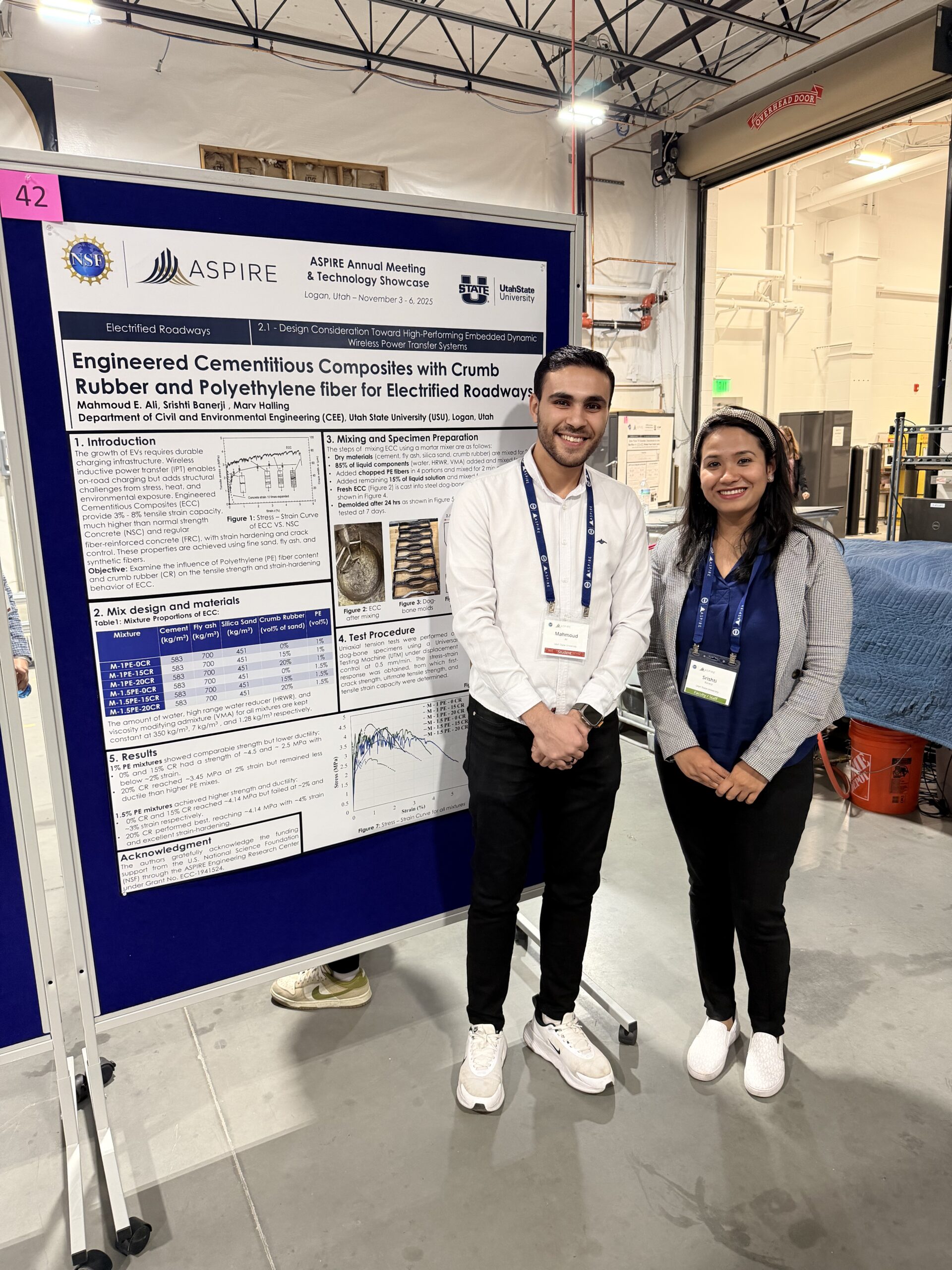
Left: Ali (left) with his mentor Srishti Banerji (right) presenting at the ASPIRE Annual Meeting.
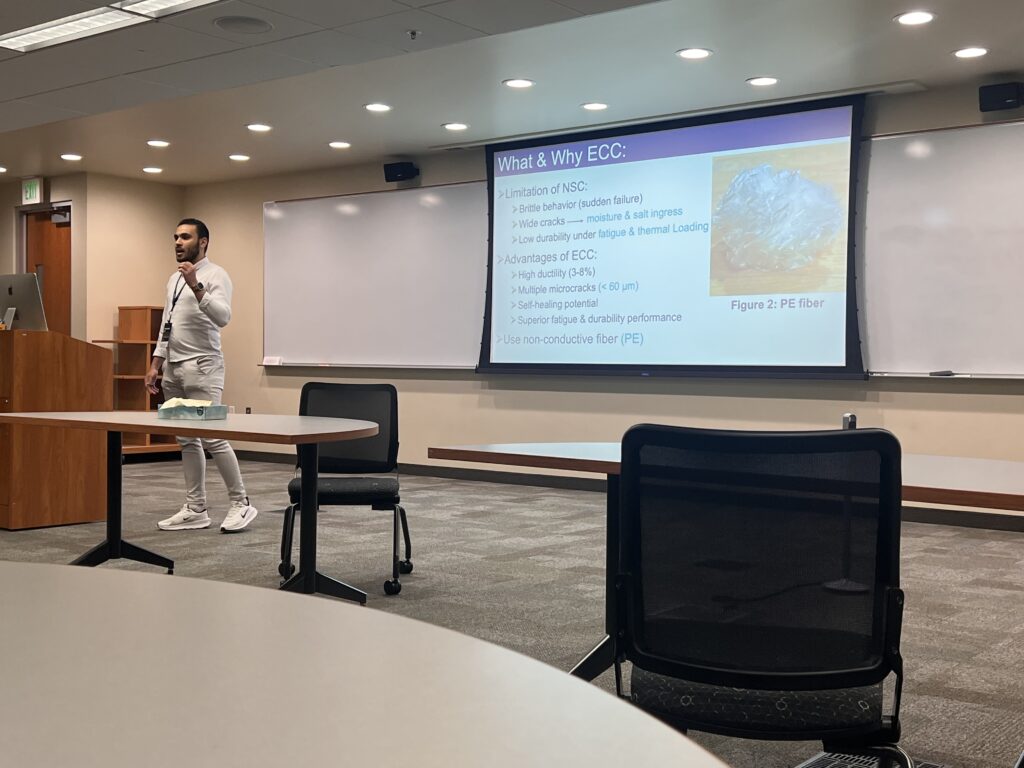
Right: Ali presenting at the USU Student Research Symposium.
Civil and Environmental Engineering Assistant Professor Srishti Banerji, Ali’s mentor, emphasized the difficulty of the ECC research Ali is conducting under her guidance.
“Developing ECC in this context is not straightforward due to the lack of established mix design guidelines,” she said. “Mahmoud encountered early challenges such as fiber clumping and workability issues, but he showed strong persistence, spending long hours in the lab refining mixtures and troubleshooting until achieving consistent results. He is resilient, motivated, and a pleasure to work with.”
During those long hours in the lab, Ali discovered that the use of synthetic fibers, such as polyethylene (PE) fibers, leads to greater ductility and durability than other concrete mixtures. Using these results, Ali will move on to the next step of his project.
“The next phase in my research is to cast three slabs, one of the slabs is normal strength concrete and the other two are ECC with different embedded coil depth,” Ali explained. “This will allow us to evaluate the ECC suitability under coupled loading conditions relevant to field applications, such as fatigue and thermal effects and compare it with the normal strength concrete.”
In this phase, the bond strength between the in-motion charging system and the adjacent concrete will be evaluated to determine the best embedment depth of this charging system that will allow for the best pavement durability and the most efficient power transfer.
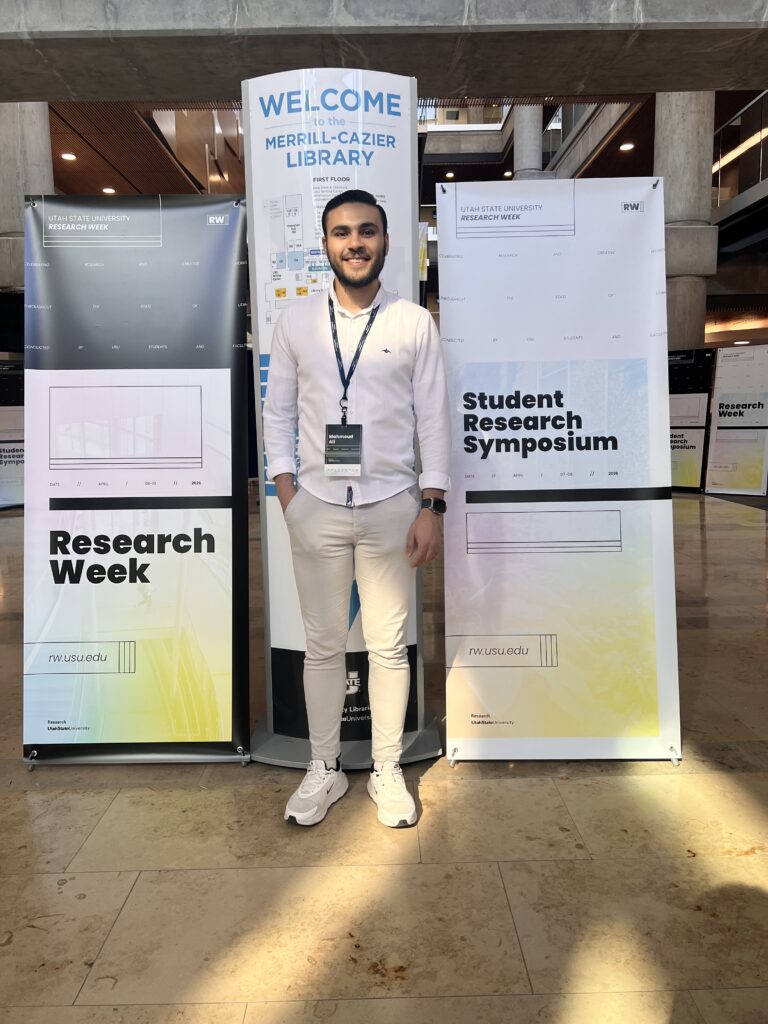
Ali’s extensive and rigorous efforts are paving the way to an electrified future.
“The significance of this work lies in its contribution to efficient and innovative transportation infrastructure,” he shared. “Electrified pavements have the potential to support electric vehicles by enabling on-the-go charging, reducing reliance on large batteries, and lowering emissions. By improving the material performance using ECC, this research helps move that technology closer to practical implementation.”
Banerji further emphasized the application of their research here at ASPIRE.
“This research is important because it is directly tied to real-world infrastructure challenges and emerging technologies of electrified transportation systems,” she shared. “Through ASPIRE, students are not just learning concepts but actively contributing to solutions that are already transitioning from lab-scale work to pilot studies and, eventually, larger implementation.”
To spread his findings with other professionals and academics, Ali presented his research at Utah State University’s 2026 Student Research Symposium, receiving interdisciplinary feedback as he contributed to the growing research community at Utah State University with innovative strides towards the future. safer, more efficient, and more practical transport solutions for the future.”
For the latest news, publications, and research highlights from ASPIRE, visit aspire.usu.edu.
About ASPIRE:
ASPIRE, a National Science Foundation Engineering Research Center headquartered at Utah State University, leads groundbreaking research and development to accelerate electrification. With over 400 global collaborators, ASPIRE focuses on creating seamless, affordable electrified transportation systems, accessible for all vehicle classes, along with the public infrastructure needed to support them. By reducing emissions, improving air quality, and fostering economic growth through job creation and workforce training, ASPIRE’s work spans engineering, social science, policy, and business. Partnering with top universities, industry leaders, and community groups, ASPIRE is driving the future of advanced transportation. Learn more at aspire.usu.edu.
Contacts:
Kat Webb
Content Director
Marketing & Communications
ASPIRE ERC
Writer:
Kayleigh Kearsley
Marketing & Communications Intern
ASPIRE ERC
Video:
J.T. Miller
Multimedia Specialist
ASPIRE ERC