Collaboration Across Disciplines: The Grid of Tomorrow Consortium

With the recent breakthroughs in technology for electrified vehicles and roadways, coupled with growth in AI and data centers, the transportation-grid edge is rapidly changing. This evolution doesn’t merely affect a single industry; rather, its impact spans across disciplines, requiring increased collaboration. Researchers, including several from ASPIRE, have founded the Grid of Tomorrow Consortium (GoTC), headquartered at Purdue University, to provide this vital opportunity for multi-disciplinary problem-solving.
“The goal of GoTC is to bring academia and industry together to address some of the most pressing challenges facing the electric power grid,” said the Consortium’s Co-Director Vassilis Kekatos. “We bring together utilities, system operators, technology providers, and the IT sector, creating a unique environment where solutions can be co-designed across traditionally separate domains. This is especially important as the power grid becomes increasingly intertwined with digital infrastructure.”
To address these challenges, GoTC has organized three successful workshops, the first in Purdue and the next two in San Ramon, California, co-hosted by founding member Pacific Gas and Electric Company (PG&E).
“The workshops helped us define research questions that are timely and relevant, such as the impact of data centers and AI on the power grid,” said Dionysios Aliprantis, former co-director of GoTC. “Listening to industry perspectives helps guide our research to address problems with significant real-world impact.”
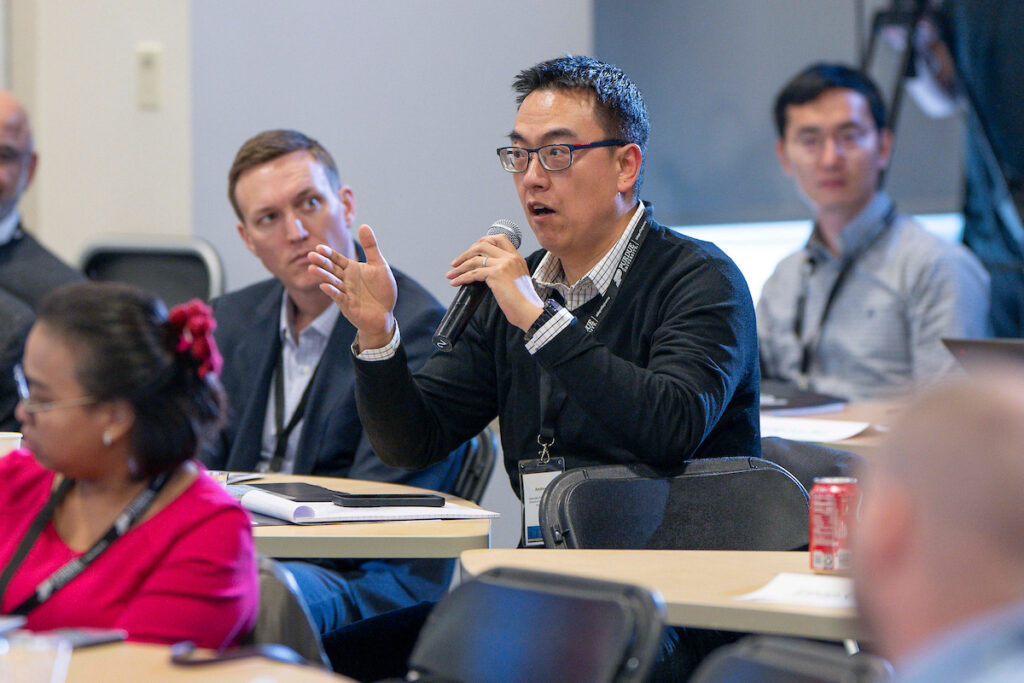

Assistant Professor Siva Seetharaman, a GoTC founding faculty member also with ASPIRE at Purdue, described the first two workshops as an opportunity to discuss major challenges and identify how best to narrow in on these solutions in future workshops.
“Our third workshop in February 2026 reflected that evolution, with a more in-depth technical discussion of these challenges and the kinds of partnerships and solution pathways needed to address them,” Seetharaman explained. “Together with our partners, we are taking leadership in defining the vision and priorities for how the future grid should evolve, and driving the conversations needed to turn that vision into practical solutions.”
Turning Constraints into Opportunities
In addition to being a founding member, PG&E is a strategic partner of GoTC. Midcontinent Independent System Operator (MISO) is also a strategic partner, while Tesla and Schneider Electric round out the consortium as full members. They joined over 200 industry leaders who worked together to problem-solve timely and important questions in February and were able to find ways to work together to improve the future grid. They addressed and examined the latest technology, including the impact of AI data centers on the power grid.
“One of the key takeaways from our February workshop was that the rapid growth in electricity demand — driven by electrification and computational loads — can be viewed not just as a challenge, but as a generational opportunity,” Kekatos said. “This moment presents an opportunity to modernize the grid in ways that improve reliability, affordability, and security.”


Another emphasis at the conference was the need to operate the grid more intentionally and intelligently, including reframing how elements of the grid coordinate with one another.
“Specifically, tighter integration between transmission and distribution operations can help unlock capacity, improve situational awareness, and support reliability in a much more dynamic environment,” said Seetharaman. “Several of the discussions also reinforced the importance of viewing flexible loads like EVs not just as challenges, but also as opportunities to build a more robust grid, if we can model, coordinate, and control them effectively.”
Throughout the process, several of the GoTC faculty members have been able to draw on their research at ASPIRE to inform these discussions and collaborate towards the future, something Seetharaman, as the ASPIRE Project 3 co-lead whose research focuses on electrified roadways, has recognized.
“My involvement with GoTC strongly complements this work as I have the opportunity to engage closely with utilities and system operators to better understand the real challenges they are facing as the grid evolves,” she explained. “That perspective directly helps connect our ASPIRE research more directly to the grid and interconnection constraints that must be addressed to achieve integration of electrified transportation at scale.”
Synergies with ASPIRE
Aliprantis, a former researcher with ASPIRE, sees a future with additional cross-over and collaboration between ASPIRE and GoTC.
“I feel that the work of ASPIRE in developing advanced electrified transportation technologies has a lot of complementarity to the work of GoTC, and I am looking forward to seeing the two centers intersecting more in the near future,” he said.
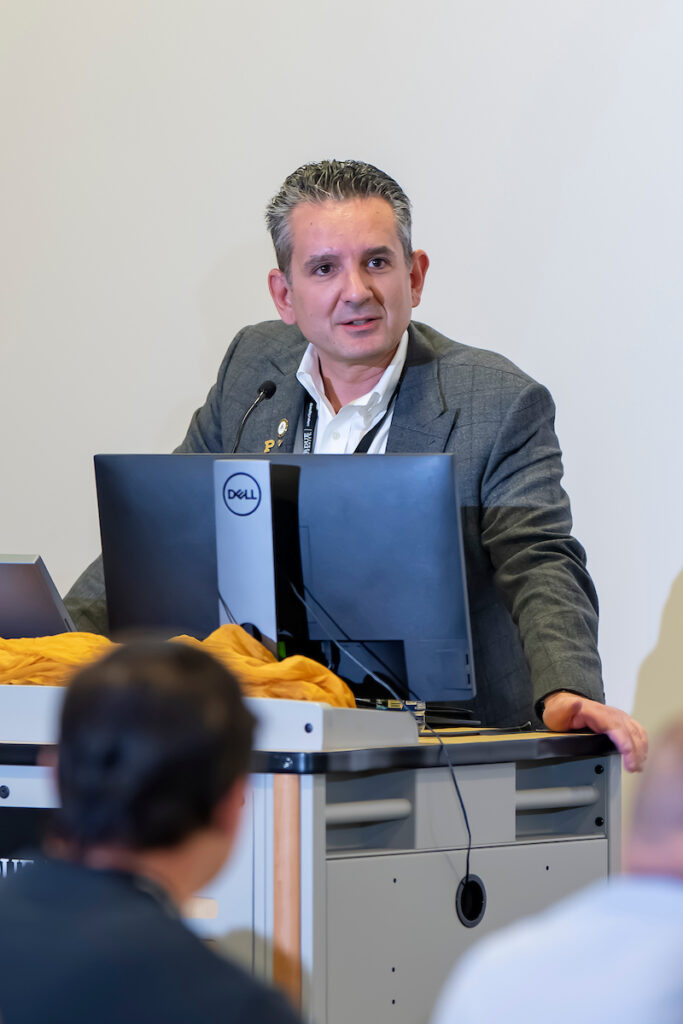

(Right): Audience at the first GoTC.
Photos courtesy of Purdue University
Kekatos also recognized the synergies that exist between ASPIRE and GoTC.
“The Purdue Grid of Tomorrow Consortium is well aligned with ASPIRE’s mission to facilitate rapid transportation electrification,” he said. “Among other research topics, GoTC researchers work on operationalizing the flexibility of electric vehicles, distributed resources, and data centers.”
In fact, Kekatos said, PG&E leaders have mentioned at past GoTC workshops that in California alone, there were 10 gigawatts of power through the vehicles on roadways, with which “the proper smart solutions can be utilized to shape supply-demand profiles, improve grid infrastructure utilization, and contribute for a more reliable and affordable power grid.”
With ASPIRE and other research centers, industries, and stakeholders, Kekatos explained that GoTC is fostering a community that prioritizes “open dialogue, shared learning, and joint problem-solving”. Building off of their current momentum, they plan to expand and invite new members to join their collaborative community.
“Our fourth workshop is currently being planned for this fall and will be co-hosted by Midcontinent Independent System Operator in Indianapolis,” Kekatos said. “We look forward to expanding participation and continuing to advance collaborative solutions for the future of the power grid.”
For the latest news, publications, and research highlights from ASPIRE, visit aspire.usu.edu.
About ASPIRE:
ASPIRE, a National Science Foundation Engineering Research Center headquartered at Utah State University, leads groundbreaking research and development at the transportation-grid edge. With over 400 global collaborators, ASPIRE focuses on creating seamless, affordable electrified transportation systems, accessible for all vehicle classes, along with the public infrastructure needed to support them. By reducing costs, improving air quality, and fostering economic growth through job creation and workforce training, ASPIRE’s work spans engineering, social science, policy, and business. Partnering with top universities, industry leaders, and community groups, ASPIRE is driving the future of advanced transportation-grid systems. Learn more at aspire.usu.edu.
About Purdue Grid of Tomorrow Consortium:
Our mission is to close the gap between academic research and industry practice to better serve the needs of the electric grid industry. The Grid of Tomorrow Consortium aspires to catalyze research and bolster workforce development for broader, evolving grid ecosystems to address the challenges posed by a rapidly changing landscape. It will serve as a forum for the electric utility ecosystem, including utilities, operators, large industrial customers and data centers, consumers, and technology providers, to:
- Share technical challenges with other members and Purdue University researchers.
- Collaborate on joint or externally funded projects that drive innovation while delivering measurable improvements in reliability and affordability.
- Recruit top talent and shape engineering education.
Contacts:
Kat Webb
Content Director
Marketing & Communications
ASPIRE ERC
Writer:
Kayleigh Kearsley
Marketing & Communications Intern
ASPIRE ERC