Bridging Perspectives: Developing the Workforce at ASPIRE
At ASPIRE, researchers aren’t only concerned with the advancements of today. They are also laying the groundwork for the future. Foeday Zinnah, an ASPIRE Ph.D. candidate at Utah State University (USU), believes workforce development to be at the center of innovation.
“My research looks at different dimensions of workforce development,” Zinnah said. “There are a lot of people talking about workforce development, but no research. People looking at the industrial perspective, but not research. We need to build the skill gaps between knowledge, human capacity, and national interest.”
Originally from Liberia, Zinnah received his bachelor’s degree in civil engineering from the University of Liberia. He then completed a master’s degree from The Hebrew University of Jerusalem in environmental soil and water sciences.
Looking for an intermediate between his degrees and pulling on his past experience in youth and community development, Zinnah came to USU for the engineering education Ph.D. program.
“Most of my life was spent working with young people, showing them leadership and entrepreneurship skills,” Zinnah said. “I decided to look for the best career that could make me move forward and also make the best impact in society.”
Zinnah was introduced to ASPIRE and for the electrification workforce development (EWD) team by his research advisor and mentor, Dr. Angela Minichiello, USU associate professor of engineering education.
“What drew me to recruit Foeday to join our engineering education graduate program and the ASPIRE EWD team were his prior experiences in experiential learning and his genuine interest in understanding what makes technology workforce pathways work,” Minichiello said. “What factors must education-industry partners address to provide accessible, appealing, and practicable technical career trajectories broadly across today’s society.”
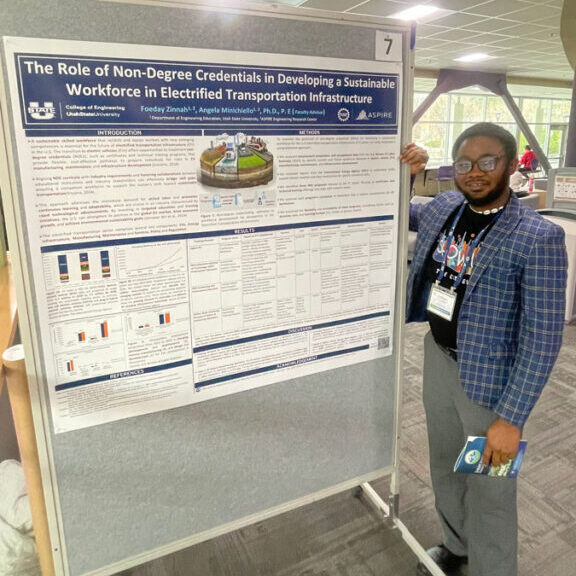
Zinnah presenting his research at the 2025 ASEE Annual Conference & Exposition in Montreal, Quebec, Canada.
Through this scope, Zinnah also seeks current perceptions on hiring and promotions in an effort to bring together people from different backgrounds. Supporting degree programs while also opening a path for non-degree credentials is something he hopes to achieve.
“Workforce development is not just about building the capacity of people who have the opportunities,” Zinnah said. “I’m trying to evolve the binary comparison between degree and non-degree and create a pathway that will make them integrate into each other.”
At ASPIRE, Zinnah was surprised by the interest in understanding education and human capacity when it comes to new technology.
“Other companies or research centers, they are just trying to get a big name in the technologies, but they are not looking at the workforce, the people who will be using the technology,” Zinnah explained. “ASPIRE is looking at the workforce, not just the higher level, but from different perspectives.”
The engineering industry can often feel difficult to break into, but as a student himself, Zinnah has seen first-hand how ASPIRE offers opportunities for students to get involved.
“We see people who are experts get older, and then they don’t have people to replace them. Building the capacity to students, exposing them to the technology, allowing them to see the future, because we are the future leaders,” Zinnah explained. “We are the ones going to meet the technology, so I think ASPIRE creating this safe space for us or creating the research center for students is very amazing.”
One opportunity that many students gain from ASPIRE is the ability to network with industry members. Zinnah is no different and has hopes that through connecting with ASPIRE partners, he can take his research to the next level. He is currently exploring opportunities in both industry and academic settings.
“ASPIRE has helped me build my relationship with other people and have conversations on how we can bring our research together,” Zinnah said. “I’m hoping that some of those conversations will be really helpful for the national interest, for ASPIRE, and for Utah State University as well.”
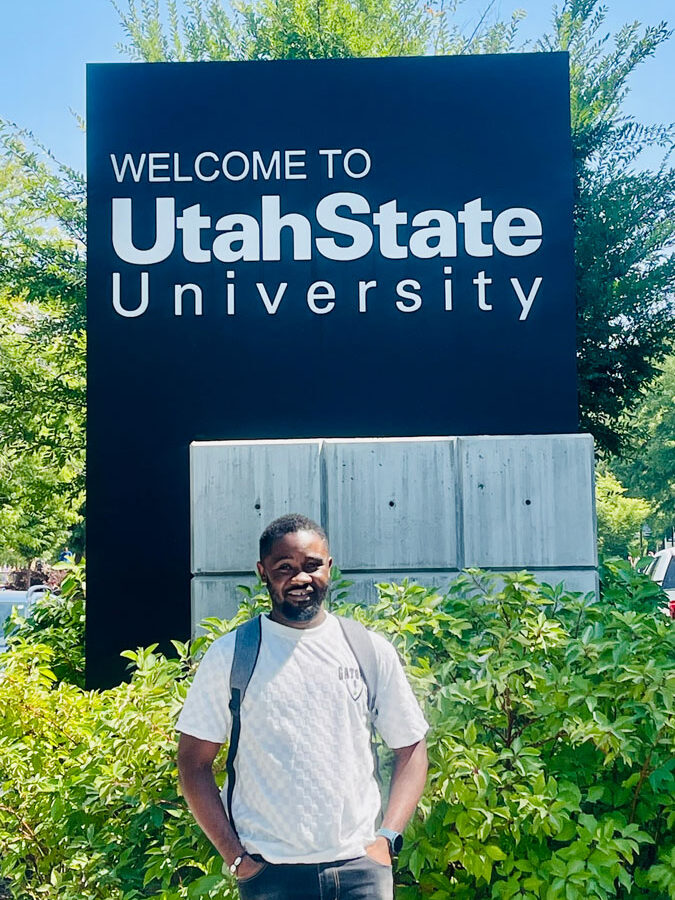
While pursuing a Ph.D. comes with a lot of responsibility, he encourages anyone with interest to go after it. The legacy you leave behind matters a lot, and Zinnah thinks the doors that working at the ASPIRE research center opens are worth the work.
“Those kinds of things seem to be a legacy you can leave behind, and it will prepare you to mentor other students or other young people,” Zinnah said. “At the end, (you are) not just giving back to society, but you are building yourself a professional career.”
For the latest news, publications, and research highlights from ASPIRE, visit aspire.usu.edu.
Contact:
Kat Webb
Brand & Strategic Communication Manager, ASPIRE Foundation
Writer:
Lucy Larson
Communications Specialist, ASPIRE Foundation
ABOUT ASPIRE
ASPIRE, a National Science Foundation Engineering Research Center headquartered at Utah State University, leads groundbreaking research and development at Utah State University, leads groundbreaking research and development at the transportation-grid edge to accelerate electrification. With over 400 global collaborators, ASPIRE focuses on creating seamless, affordable electrified transportation systems, accessible for all vehicle classes, along with the public infrastructure needed to support them. By reducing costs, improving air quality, and fostering economic growth through job creation and workforce training, ASPIRE’s work spans engineering, social science, policy, and business. Partnering with top universities, industry leaders, and community groups, ASPIRE is driving the future of advanced transportation-grid systems. Learn more at aspire.usu.edu.