Dynamic Charging Takes to the Road
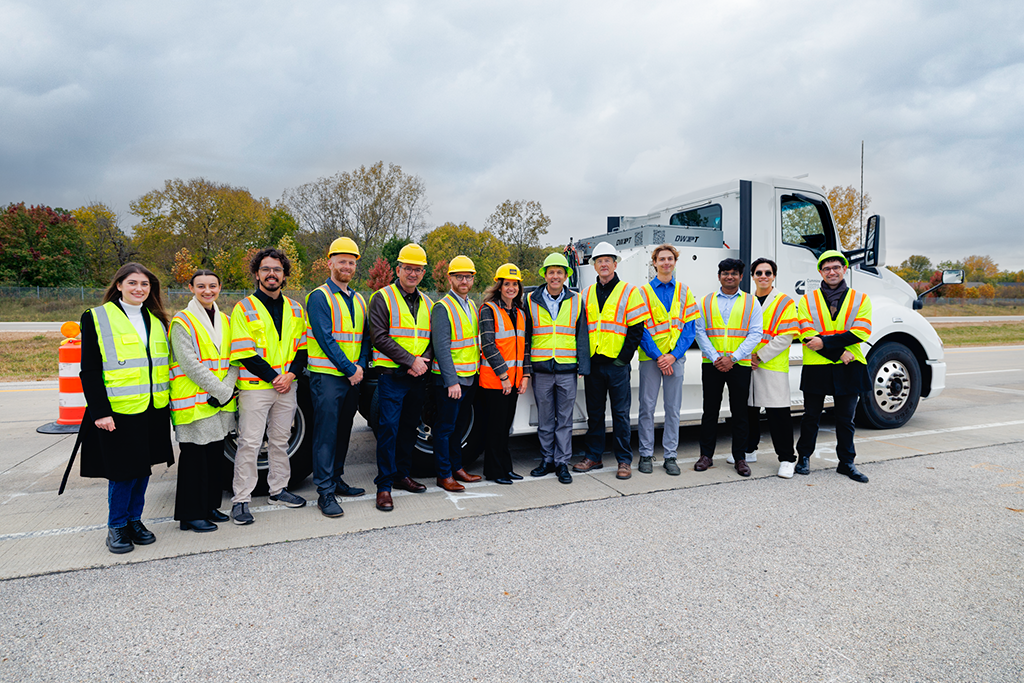
ASPIRE researchers from Purdue University
ASPIRE researchers at Purdue University, working with the Indiana Department of Transportation (INDOT) and local industry partners, took a significant step in advancing technology for electric vehicles and roadways. Recently, the Joint Transportation Research Program (JTRP) published “Receiver, Vehicle, and Roadway Systems for a Dynamic Wireless Power Transfer (DWPT) Roadway Testbed”, an article highlighting ASPIRE’s results successfully demonstrating wireless charging of a moving Class 8 truck on U.S. 52/231.
The DWPT system delivered 50 to 190 kW of power to a retrofitted heavy-duty truck traveling at speeds up to 65 mph, while achieving efficiencies approaching 85%. Testing also showed reliable performance, strong tolerance to vehicle misalignment, and magnetic field levels well below established human exposure limits for the established electromagnetic safety guidelines.
For Oscar Andrés Moncada, the lead Civil and Construction engineering student, the project’s central objective was to “transition the implementation of DWPT technology from a laboratory setting to a real public highway in Indiana.”
Achieving that goal requires innovation from both civil and electrical engineering perspectives. The team needed to safely embed charging hardware into an existing concrete roadway while maintaining pavement performance and minimizing impacts on traffic. At the same time, researchers developed the transmitter coils, power electronics, and vehicle-mounted receiver systems needed to transfer energy wirelessly to a moving truck.
Each element of the system had to perform independently before being integrated into the full charging corridor. The roadway needs to detect an approaching vehicle, transfer power smoothly between successive coils, and deliver useable energy for fully loaded heavy-duty highway speeds.
Collaboration Creates Significant Milestones
The result marked a global milestone for transportation infrastructure.
“It’s remarkable to look back at how we moved from a financial and technical feasibility study to a laboratory prototype, and now to full-scale implementation,” Moncada said. “This is the first dynamic wireless power transfer roadway built into a rigid pavement, both in the United States and in the world.”
For researchers, that progression from concept to implementation demonstrates how coordinated research efforts accelerate emerging technologies in multiple areas of study.
“Seeing how civil and electrical engineers approach the same problem from completely different starting points, and watching those approaches converge on a working solution has shaped how I think through a research problem myself,” Moncada shared.
That collaboration extended well beyond Purdue researchers. INDOT, civil and electrical contractors, graduate students, and local and center-wide ASPIRE researchers all played critical roles in bringing the project to life.


Challenges On the Road
Moving the technology from the lab to field created challenges of its own.
“The biggest challenge of the technology itself was moving this project forward from laboratory scale into a real implementation on a working public highway in Indiana,” Moncada said.
Construction was performed while traffic remained active in an adjacent lane, requiring careful coordination and attention to safety. Because no previous rigid-pavement DWPT installation existed on public roads in the U.S., researchers had no established construction conditions and methods to apply.
“The most complex part of the construction procedure was finding a path for the electrical connections to travel from underneath the driving surface all the way out to the equipment housed along the shoulder, without disturbing the road structure itself,” Moncada explained.
For electrical engineering researchers Vatan Mehar, Isaac Abram, and Nicholas Frooninckx, the project was an opportunity to evaluate whether dynamic wireless charging could become viable transportation infrastructure to validate and refine system components before moving the vehicle testing to the highway.
The electrical engineers wanted to determine whether dynamic wireless power transfer could move beyond the laboratory and work as practical transportation infrastructure. Throughout the project, the team answered that, and more. They determined up to 200 kW could be transferred across an air gap of roughly 20 centimeters while a Class 8 electric truck traveled at highway speed. They also evaluated durability, environmental performance, magnetic field exposure, and the effects of real-world operating conditions on the system.
“One of the most interesting lessons was how much real-world construction variability matters,” Abram said. “Small differences in installation, dimensions, and component placement can add up and affect system behavior, so the design has to be robust to those variations.”
The team was also encouraged by the system’s thermal performance. Roadway transmitter coils experienced relatively modest thermal stress, and the infrastructure did not require active cooling at the transmitter level. Magnetic field measurements further demonstrated that exposure levels could remain within established safety guidelines.
Testing on an active highway introduced a very different set of obstacles than researchers typically encounter in laboratory environments. Weather conditions, traffic control requirements, limited site access, and construction schedules all influenced testing activities. At the same time, researchers faced aggressive timelines to complete installation, validation, and performance testing.
“One of the biggest challenges was simply operating and troubleshooting an experimental system on an active highway,” Frooninckx shared.
The complexity of the system added another layer of difficulty. Mechanical and electrical subsystems were tightly integrated, making troubleshooting a significant challenge. Equipment had to withstand water, road debris, temperature swings, and other environmental conditions rarely encountered during laboratory testing.
Despite those obstacles, the team successfully met all project objectives on schedule.
A roadmap for the Future
The researchers believe the project’s greatest contribution is what it demonstrates about the future potential of dynamic wireless charging.
“The biggest takeaway is that dynamic wireless charging is no longer just a laboratory concept,” Nick Frooninckx explained. “We demonstrated that substantial power can be transferred to a heavy-duty electric vehicle while it is moving on a real roadway.”
The results showed that the roadway could reliably detect a vehicle, transfer power from transmitter to transmitter, and sustain charging at highway speed. Researchers highlighted the advantages of the project’s three-phase system, which demonstrated strong tolerance to vehicle misalignment, an important consideration for real-world driving.
Looking ahead, the team sees opportunities for continued improvements in coil design, power electronics, control systems, and construction methods. However, the successful demonstration suggests that large-scale deployment may be more achievable than many previously believed.
“This project moved through a steady progression, from a financial and technical feasibility study to a laboratory prototype, to the full-scale implementation on an Indiana public highway,” Moncada said.
Construction proved successful, and so did the charging performance. While additional optimization remains, the project demonstrated that dynamic wireless power transfer can function on a public roadway, providing a credible path toward future infrastructure that supports heavy-duty electric transportation.
Read the technical report here: Receiver, Vehicle, and Roadway Systems for a Dynamic Wireless Power Transfer Roadway Testbed
For the latest news, publications, and research highlights from ASPIRE, visit aspire.usu.edu.
Contact:
Kat Webb
Brand & Strategic Communication Manager, ASPIRE
Writer:
Anna Cliff
Marketing & Communications Specialist, ASPIRE
ABOUT ASPIRE
ASPIRE, a National Science Foundation Engineering Research Center headquartered at Utah State University, leads groundbreaking research and development at the transportation-grid edge to accelerate electrification. With over 400 global collaborators, ASPIRE focuses on creating seamless, affordable electrified transportation systems, accessible for all vehicle classes, along with the public infrastructure needed to support them. By reducing costs, improving air quality, and fostering economic growth through job creation and workforce training, ASPIRE’s work spans engineering, social science, policy, and business. Partnering with top universities, industry leaders, and community groups, ASPIRE is driving the future of advanced transportation-grid systems. Learn more at aspire.usu.edu.