Best Paper Award: A Collaborative Effort to a Researcher’s Milestone
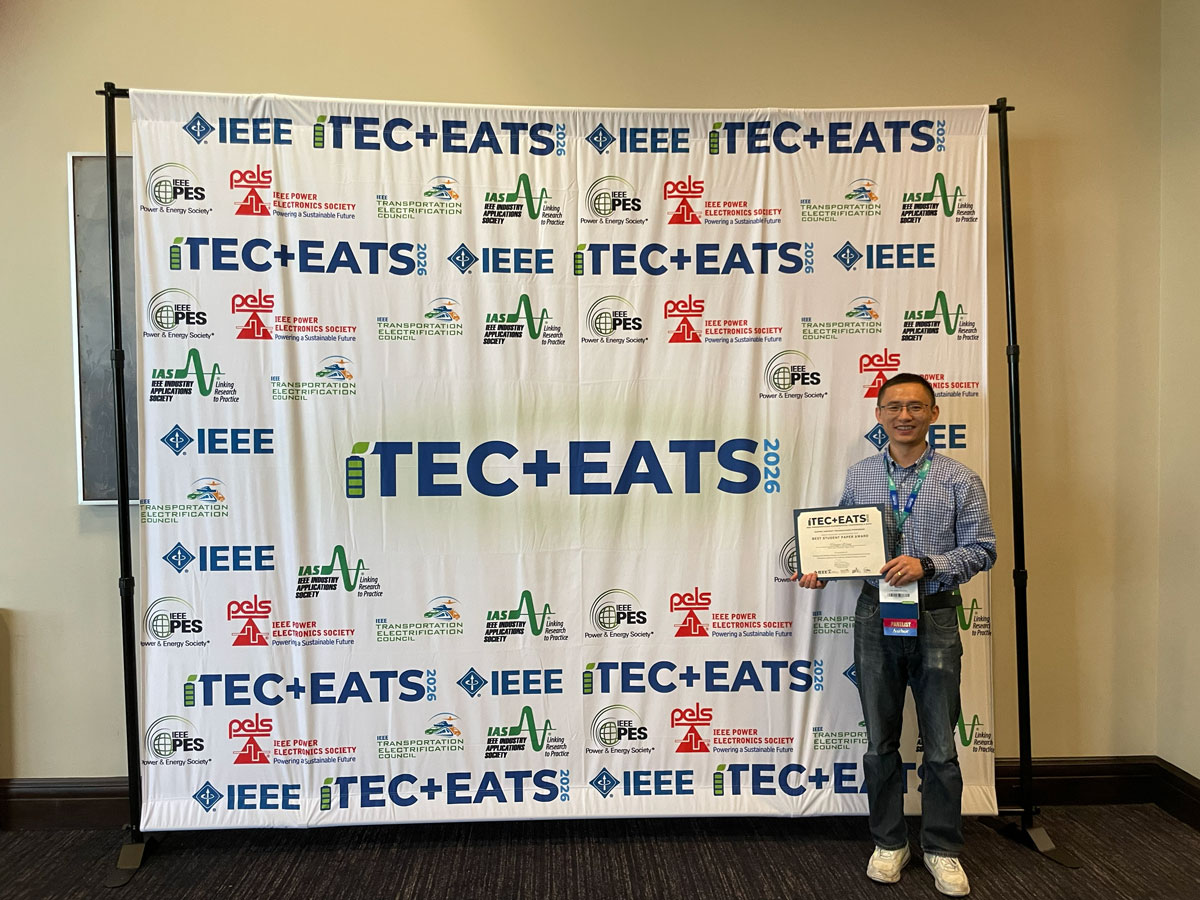
When up against a couple hundred other research papers, it can be difficult for your research to stand out. Yet standout is exactly what one Utah State University research team from ASPIRE did last month at an electrified transportation conference with their paper, “Modeling and Stability Analysis of a Modular IPOS-Connected DC Current Distribution System for EV In-Motion Wireless Charging System.”
“We are truly honored and grateful to receive this Best Paper Award. With only four papers selected from more than 200 published papers, this recognition is especially meaningful to us,” said Electrical and Computer Engineering Professor Hongjie Wang. “It is very rewarding to see our work acknowledged by our peers and the IEEE Transportation Electrification Conference & Expo + IEEE Electric Aircraft Technologies Symposium (ITEC + EATS) community.”
The research behind this award-winning presentation is a continuation of the research recent Ph.D. graduate Shubhangi Gurudiwan conducted under the direction of her advisors, Hongjie Wang and Regan Zane, and was made possible through the assistance of coauthors Ph.D. candidate Mckay Waite and recent graduate Aditya Zade.
“This work extends my earlier research on modular EV charging systems,” Gurudiwan explained. “My previous work focused on plug-in dc fast charging (DCFC) using voltage-regulated modular architectures, whereas this project explores dc current distribution, which introduces fundamentally different stability and control challenges.”
This research addressed the challenges of power distribution methods to the inputs of a variety of chargers, including both wired and wireless charging infrastructure, both stationary and dynamic (in-motion charging). It focused on large-scale EV charging, which must withstand spikes in power demand if multiple vehicles stop and begin charging simultaneously. The solution they found was also the most efficient and cost-effective method.
“Early results show that shifting from a DC voltage-based to a dc current distribution system can reduce cabling requirements and overall losses. These benefits become more significant at high EV penetration levels, where large-scale dynamic wireless charging would require simultaneous power delivery to many vehicles on the road,” Gurudiwan explained. “This work highlights the stability constraints required to ensure overall system stability when multiple transmitters simultaneously draw power from the distribution network.”

An important aspect of this research was the framework developed to monitor the stability of this infrastructure, even with future charging expansions, something that Waite, an electrical engineering student at USU, assisted with.
“Our research developed a framework for analyzing the stability of a modular dc current distribution architecture for dynamic wireless EV charging,” Waite explained. “The results provide design guidelines that help ensure the system remains stable and scalable as additional charging modules are added.”
Through their research, they discovered that while dc current distribution is a promising approach for these large-scale EV charging systems, due to the reduction in distribution losses and cabling requirements, especially when multiple vehicles are charging simultaneously. However, due to the multiple systems and working parts, it required multiple systems to be used in tandem to stabilize the charger infrastructure, according to Zade, who also recently graduated with his Ph.D. under the direction of his advisor Zane.
“This type of system requires careful modeling and stability analysis because the power source, IPOS-connected modules, and current-fed transmitters all interact with each other,” he said. “The paper shows that phasor-transformation-based mod, droop-based output-voltage balancing, and impedance-based stability analysis can be used together to achieve stable operation.”
Their efficient and cost-effective solutions for large-scale EV charging infrastructure highlight the research advancements and technologies necessary to accelerate the electrification of transportation, supporting ASPIRE’s efforts.
“This work directly supports ASPIRE’s mission by addressing key technical challenges that are critical to the widespread deployment of cost-effective, reliable, and scalable charging infrastructure,” Wang said. “The recognition of this research through the Best Paper Award also highlights the impact of ASPIRE’s research in advancing the future of electrified transportation.”
These critical efforts and the subsequent recognition were classified as a “highly valued milestone” by Gurudiwan, allowing her to appreciate how their efforts fit into the broader field at ASPIRE and further into the field of electrified transportation.
“The award validates the relevance of this research direction for future EV infrastructure, where a combination of solutions — ranging from plug-in charging to static and dynamic wireless charging — will be necessary,” she said. “I am thankful to my coauthors for all the support and input that made this possible.”
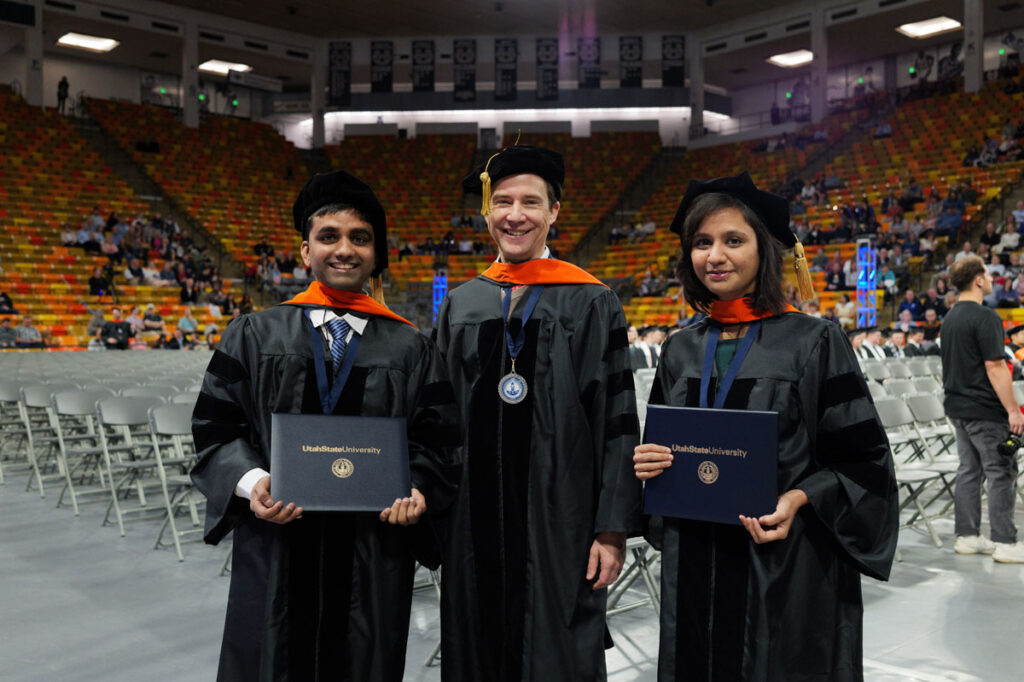
The importance of teamwork and developing this paper with multiple coauthors was felt by each of the students.
“One thing I continue to appreciate is how much research builds on collaboration,” Waite said. “This project brought together expertise in different aspects of the system, and that combination made the final work much stronger than any one person could have produced.”
Zade added the collaborative effort will continue to fuel his motivation to pursue future research and projects.
“This award is a meaningful recognition of the team’s effort and of the importance of this research direction. As a coauthor, I am grateful to have contributed to work that received this recognition,” he said. “It motivates me to continue working on high-impact power-electronics technologies for EV charging, grid-interface converters, and future energy systems.”
For the latest news, publications, and research highlights from ASPIRE, visit aspire.usu.edu.
About ASPIRE:
ASPIRE, a National Science Foundation Engineering Research Center headquartered at Utah State University, leads groundbreaking research and development at the transportation-grid edge. With over 400 global collaborators, ASPIRE focuses on creating seamless, affordable electrified transportation systems, accessible for all vehicle classes, along with the public infrastructure needed to support them. By reducing costs, improving air quality, and fostering economic growth through job creation and workforce training, ASPIRE’s work spans engineering, social science, policy, and business. Partnering with top universities, industry leaders, and community groups, ASPIRE is driving the future of advanced transportation-grid systems. Learn more at aspire.usu.edu.
Contacts:
Kat Webb
Content Director
Marketing & Communications
ASPIRE ERC
Writer:
Kayleigh Kearsley
Marketing & Communications Intern
ASPIRE ERC